

Something substantial is going up beside Allandale Road. Attacq Limited, the property company behind Mall of Africa, broke ground on Waterfall City Junction in November 2025, part of close to R1bn in precinct infrastructure the group has committed across Waterfall City. The scale of the site runs to 1.5 million square metres carrying approved development rights of 600 000m². If your lease expires anywhere between now and 2028, this one belongs on your radar.
What Is Waterfall City Junction, the New Logistics Park in Midrand?
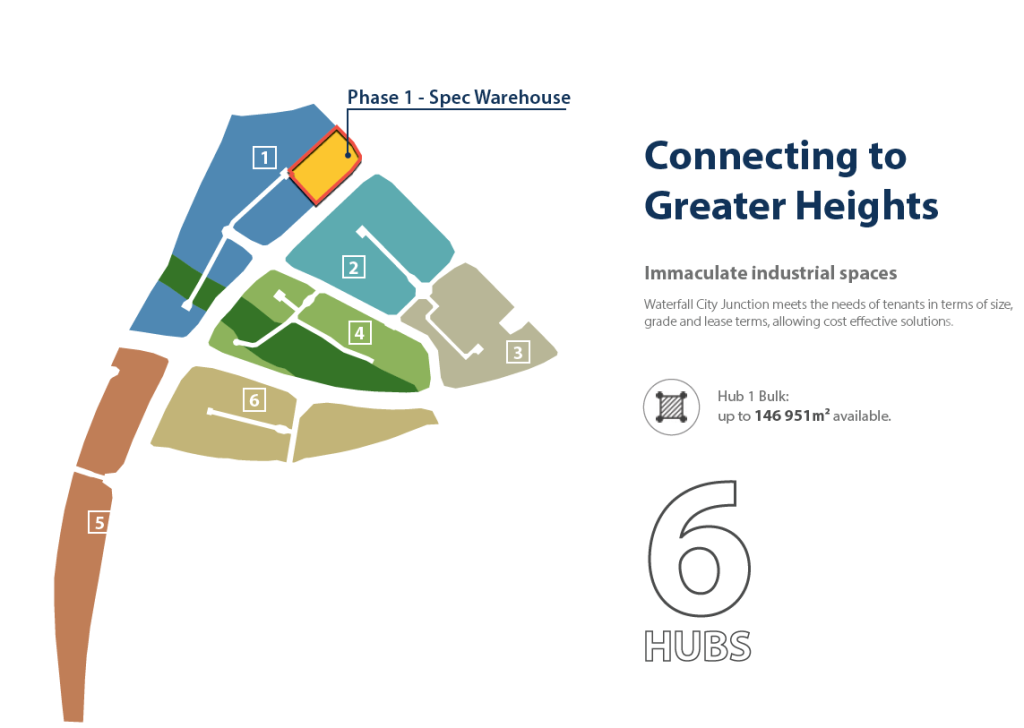
The land sits in the north of Johannesburg, bounded by Allandale Road along one edge with the proposed K113 route running down its western side. Attacq holds the development alongside Sanlam Properties, which came in as joint shareholder. Six hubs make up the master plan, though bulk infrastructure services only the first four so far. Attacq is staging the spend against take-up.
Hub 1 goes first, and Attacq’s July 2025 spec brochure puts total hub area at 375 226m² across 11 leasable erven, of which 294 965m², or 79%, becomes leasable land. Potential bulk reaches 144 451m². The same brochure flags all of it as subject to design development, so the figures will move before the drawings settle.
Developers in Gauteng today favour the Bankenveld district release model, putting serviced land out in tranches as tenants commit, which spares them a speculative bet on an entire precinct at once.
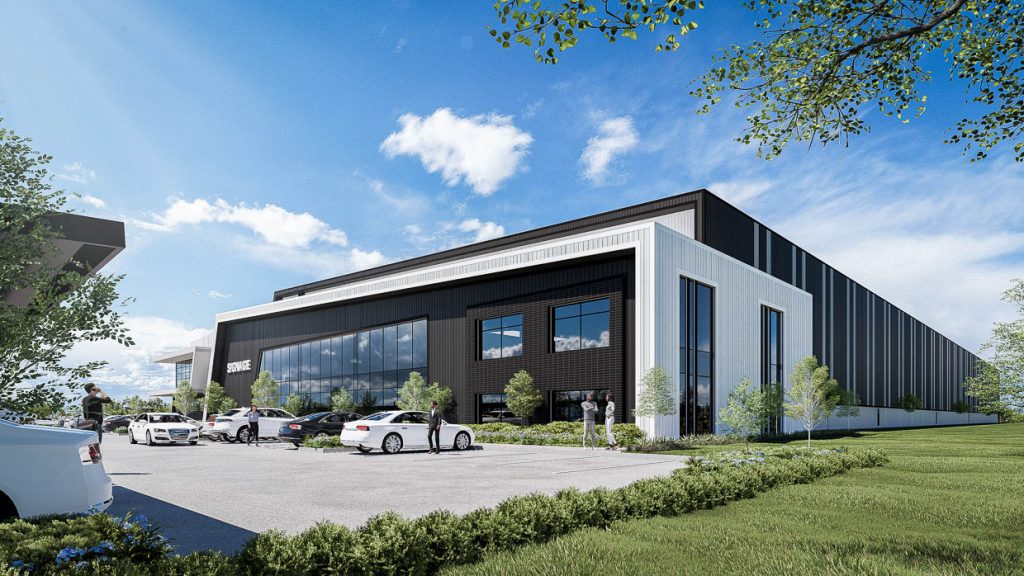
Inside the Phase 1 Warehouse Space at Waterfall City Junction
Phase 1 lands on Parcel 1.2, a 45 758m² stand hugging the Allandale Road edge of Hub 1. The building rising there covers 22 000m² in built area for a bulk ratio of 0.48, which leaves real room around the structure for the yard, the parking, the circulation that makes a distribution building function. Warehouse floor accounts for 20 000m². Offices take the remaining 2 000m² over two storeys, with 134 parking bays serving both.
Attacq’s own reporting sharpens those numbers. The latest development pipeline figures put the speculative warehouse at 22 142m² costing R253.4 million, targeting completion in the third quarter of 2027, with a second building of 16 072m² going up alongside under a half-share joint venture with the client who will occupy it, at R277.7 million.
Speculative space changes what you can do as an occupier. You walk the slab, you measure the eaves, you watch the steel go up, all before you sign, which beats reading a drawing set while hoping the contractor delivers what it promised. You also skip the 12 to 18 months a full design and build cycle swallows before your first pallet lands.
Baseline Specifications for This Logistics Park in Gauteng
The brochure specification reads modern distribution grade throughout.
- 13.5m spring height, described by the developer as extra eave height for racking and storage
- 40m yard depth for truck circulation
- Six docked levelling doors, fitted with dock levellers where appropriate
- Six on-grade doors for additional loading
- 190mm thick large panel floor, specified to FM2 flatness
- Centralised sprinklers at a 12.5mm per minute baseline density, certifiable by the Automatic Sprinkler Inspection Bureau (ASIB)
- Controlled access security points, backed by 24 hour off-site monitoring
- Fibre-ready units from the day you move in
Spring height decides how much you store per rand of rent, which is why 13.5m earns its place at the top of that list. The 40m yard depth does similar work on the other side of the wall, giving an interlink room to swing without a three-point turn. Your insurer, meanwhile, will care about ASIB certification long before you do.
Resilience is where the precinct makes its strongest case in a South African context. Warehouse roofs designed for future solar come with off-site stormwater systems plus five days of backup water per development. Across the wider Waterfall City, Attacq reports solar capacity already installed there reaching 1.3 MWp. Water backup runs to 1.3 million litres, and occupiers traded through a five-day power outage on those systems.
Do not skim the office component either. Two thousand square metres over two floors houses a real workforce, so the same discipline you bring to picking office space that works applies here in full. Natural light, parking ratios, ablution counts all decide whether your team settles into a building or quietly resents it.
Why the Location Works for a Distribution Centre in Johannesburg
Location does most of the work in this deal. The brochure lists OR Tambo International Airport 17.1km out, a 24 minute run on a clear morning. Sandton is 17.7km at roughly 21 minutes, Rosebank Gautrain station 21.9km at around 22, Pretoria 45.9km at close to 39. Three airports fall inside a 31km radius once you count Lanseria with Grand Central, while the N1 runs straight past the gate.
Waterfall City hands you highway access alongside a workforce catchment, with Midrand Gautrain station roughly 5km from Mall of Africa for the office contingent. The precinct also carries a tenant roster most new parks would envy.
Waterfall City’s 1934 farm purchase seeded a node now housing Deloitte, PwC, BMW, Dis-Chem, with logistics occupiers such as Cotton On, Amrod, Cummins already settled nearby. The designers laid the internal roads out for the longest interlink, with turning circles to match, which is the sort of detail you notice only when it is missing.
The wider corridor keeps attracting capital. The Kyalami racetrack redevelopment story plays out a short drive west, lifting the profile of the whole Midrand belt.
Industrial Property in Midrand and the Wider Gauteng Market
Timing sits in your favour or against it, depending which side of the table you occupy. Rode third quarter industrial data put national industrial vacancy at 3.8% in the third quarter of 2025, a slight rise from 3.6% a year earlier, while nominal gross rentals on 500m² units climbed 8.4% over the same 12 months. Gauteng’s East Rand posted 7.1% growth, with Central Witwatersrand at 4.3%.
Rents rising into a small vacancy uptick tells you something about where the pressure sits. Modern stock keeps letting while older stock carries the empties, which is the pattern behind why Gauteng warehouses keep filling at the quality end of the market.
The First National Bank (FNB) Commercial Property Finance survey for that same quarter recorded something absent since 2019, with national demand outstripping available supply across the industrial, office, retail sectors at once. One listed South African logistics portfolio reported vacancy of 0.3% at the end of October 2025, a historic low for that group, though a single portfolio is no proxy for the wider market.
Investors reading numbers like those often reach the sector through a Real Estate Investment Trust (REIT). How listed property funds work comes down to owning income-producing buildings, then distributing most of the earnings to shareholders. South Africa’s industrial sector has spent several bruising years outperforming every other property sector, so a precinct arriving now finds a receptive audience.
What to Check Before You Rent Warehouse Space in Gauteng
New stock gives you choices, which is where occupiers usually come unstuck. Yard depth, floor loading, sprinkler density each decide what your operation can physically run, so measure them against your real pallet flow before the spec sheet seduces you. Racking height pays nothing back until your materials handling equipment can reach it.
Permitted use deserves an early look, since what zoning allows on site governs whether you may store or process what your business handles. Lease structure will move your true cost as much as the building does, because escalation, operating expense recoveries, beneficial occupation dates all bite, which puts what lessees should check first squarely in play at this stage of construction.
Timing may simply not suit you. If your lease expires well before 2027, space available across Gauteng now will bridge the gap while the precinct finishes.
One caution on the brochure. It describes the site as roughly 10 kilometres from Sandton, then its own distance table records 17.7km. Straight-line measurement against road distance probably explains the gap, though you want written confirmation before you build a delivery model on either number.

Find Commercial Property in Waterfall City with PH Real Estate
Good logistics stock in the northern corridor moves quickly, so the useful conversations happen early. PH Real Estate brings two decades in commercial property across Midrand, Waterfall, Bryanston, Fourways, and what a commercial broker does includes reading a spec sheet the way the landlord’s team would. Send us your space requirement for a shortlist, whether that points at Waterfall City Junction or somewhere else in Gauteng entirely.